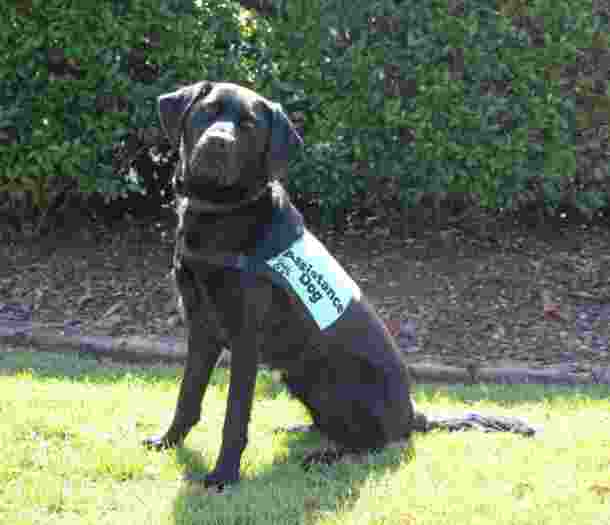
Psychological Assistance Dogs (PTSD Dogs)
GDQ is currently developing a new service to support members of the community with a formal PTSD diagnosis. The service builds on our 65-year history of breeding, raising, and training as well as its commitment to co-design and client-centric care.

Skills to alleviate symptoms
PTSD Dogs can perform a large array of skills to address clients’ symptoms, enhancing our client’s independence and allowing them to navigate the world with confidence. These range from the preservation of personal space and grounding during flashbacks through touch, waking their handler from a nightmare to the interruption of distress.
Best in class support
GDQ goes above and beyond to provide the best support possible to clients with PTSD.
There are four specific advantages we offer:
Purpose-bred dogs
Our world-class dog breeding centre uses insights from our colony and the international working dog registry to maximise the likelihood of good health, behavioural suitability and a successful client match. This reduces long-term medical costs and provides a strong foundation on which to raise a wonderful, highly trained dog.
Early socialisation and education
Our dogs receive their own version of early years education through our puppy socialisation and education program. This ensures that our dogs remain calm and well-disciplined around distractions such as other dogs and crowds. Our dogs are a constant, not a variable.
World-class training and animal welfare
While many assistance animals are trained to complete 3 tasks, ours are trained to carry out 25-30 tasks. These range from high-level obedience and environmental soundness to symptom alleviation and life-skills support. Importantly, we work with psychologists to understand the best skillset for each client, enabling co-design during the training process.
Client support
Each dog has its own unique personality and physical attributes, so we take the client-dog matching process very seriously. Our aim isn’t just to place dogs but to ensure a successful long-term match by providing extensive, pre- and post-placement support.
Applying for a PTSD Dog
We prioritise clients based on the best match to our qualified PTSD Dogs.
Please note, there are specific criteria that we need applicants to meet to be considered for placement of a PTSD Dog, which will increase the likelihood of successful outcomes:
- A formal diagnosis of PTSD from a registered psychologist, who has provided ongoing support for more than 6 months.
- Physical and mental capacity to handle and work with a large breed dog (Labrador).
- A supportive home environment.
- The ability and willingness to undertake a training program and learn new skills/tasks.
We are currently piloting our service and have temporarily closed applications due to the high level of interest we have received. We will reopen the process when we are able to consider additional enquiries.
Please check back for updates or future opportunities.
Exclusions
GDQ provides a full-service PTSD Dog program but does not act as a contract dog trainer for 3rd parties. As such, we do not:
- Accredit owner-trained dogs
- Work with dogs/breeds outside our colony of Labradors
While GDQ does place facility dogs with institutions for various purposes, we do not currently provide dogs for conditions other than PTSD at this stage (e.g. autism, seizure alerts).

Resources
-
Download
PTSD Dogs Brochure
Find out more about our Psychological Assistance Dogs.
Ready to continue?
Seems like you have filled this form earlier. Let’s pick up where you left off.